Cognitive Revolution
The Cognitive Revolution was the mid-20th-century shift in psychology back to studying internal mental processes after decades of Behaviorism.
Why open the black box again?
Behaviorism’s stimulus-response framing couldn’t explain language, memory, or attention. Psychology needed to open the black box.
Behaviorists treated the mind as a black box: stimuli entered, a response came out, the inside was unknowable. They focused only on stimulus-response associations, leaving topics like memory unexplored.
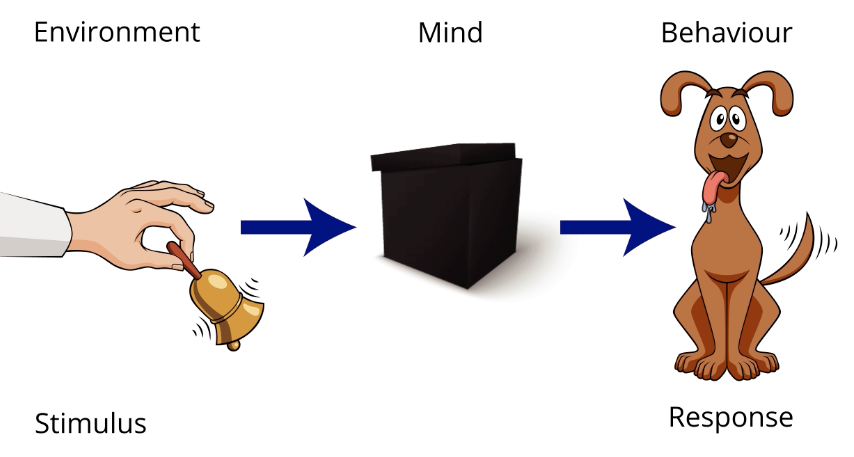
Four currents pushed psychology back toward the mind:
- Human factors engineering: machines had to be designed around human cognitive limits, which led to the idea of humans as limited-capacity information processors
- Linguistics: Chomsky criticized Behaviorism. Children produce novel sentences they were never directly taught, so language can’t just be imitation plus reinforcement
- Neuroscience: Hebb, Hubel, and Wiesel showed that cognitive functions have biological / neural bases
- Computers and AI: the computer metaphor of the mind. Mind as a system that takes in, stores, transforms, and outputs information
Together they made it respectable to talk about internal representations and processes, opening the door to cognitive psychology.