GPU Optimization
The goal of GPU optimization is to push CUDA workload closer to peak hardware throughput.
Generally, we try to identify whether memory, compute, or kernel overhead is the current bottleneck and then apply the technique that attacks that bottleneck.
Also see LLM Optimization for more specific techniques related to LLM-style architectures.
Resources
- Source: Jane Street ML Talk
- GTC Talk 2026: Five Bottlenecks, Five Fixes: How We Avoid Leaving Training Performance on the Table by Corwin and Sylvain
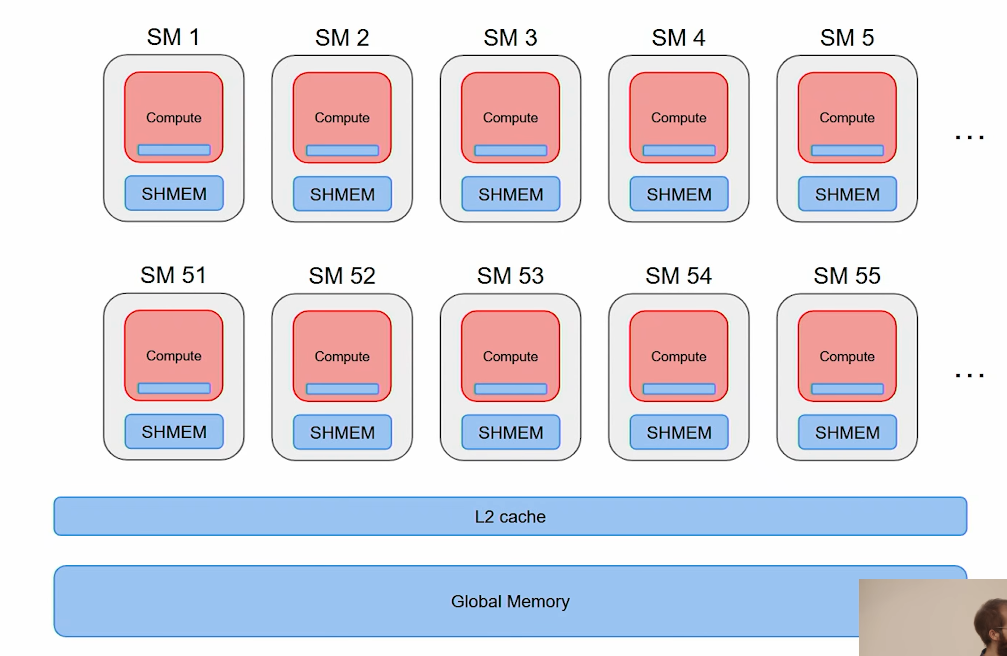
Why does this taxonomy matter?
Naive C of a 2048×2048 matmul on an Apple M2 hits ~0.005% of peak. Hand-vectorized + cache-blocked across all CPU cores: ~1%. The Neural Engine: ~80%. Six orders of magnitude on the same chip (MIT 6.S894 Lec 1, slides 13-23). Every rung you climb is a memory, compute, or kernel-overhead win, and you can’t reason about which one without knowing where the workload currently sits. See MIT 6.S894 for the framing.
Guiding principles
- data reuse, keep data in registers and shared memory as long as possible, load once and use many times
- Latency hiding, overlap slow memory transfers with computation via prefetching and CUDA streams
The 3 bottlenecks
- Memory: GPU is busy moving data around, very little time on compute. Lots of HBM ↔ SRAM traffic relative to FLOPs. Attack with locality
- Compute: most time is actual computation. Generally a good state, but may still be pushable with Tensor Cores or better algorithms. Profile with Nsight Compute
- Kernel overhead: launch overhead dominates, especially with many short kernels. Attack with fusion or CUDA Graphs
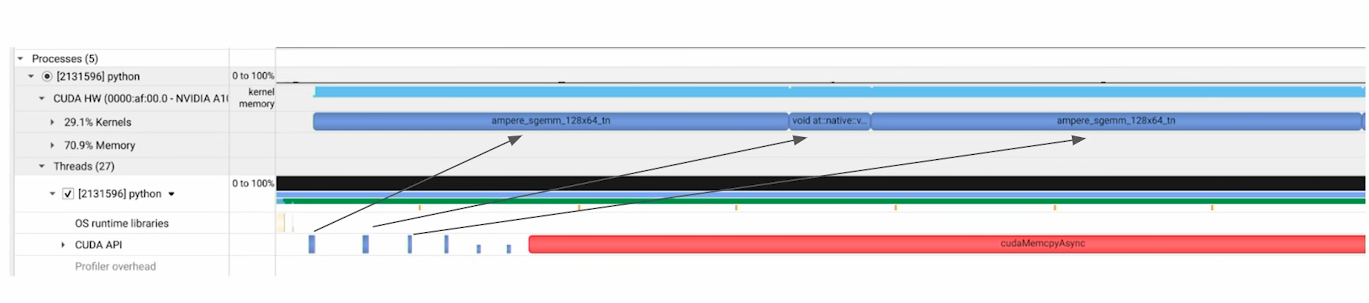
- visualization of kernel launching
- Memory bottleneck (within GPU):
- Compute Bottleneck:
- Kernel Overhead:
- Kernel Fusion
- Leverage CUDA Graph
More techniques inside LLM Optimization.
CUDA optimization checklist (PMPP Table 6.1)
A list of techniques taken from the PMPP book:
- Maximize occupancy
- Enable memory coalescing by being aware of RAM access order
- Minimize control divergence within warps
- Tiling
- Privatization, each thread works on its own copy, reduce at the end
- Thread coarsening, do more work per thread to amortize per-thread overhead
Profiling
Use Jupyter Nsight and Nsight Systems to see which bottleneck you’re actually hitting before picking a technique.