Barrier Synchronization
Saw this while reading the PMPP book, chapter 3.
A barrier for a group of threads or processes in the source code means any thread/process must stop at this point and cannot proceed until all other threads/processes reach this barrier.
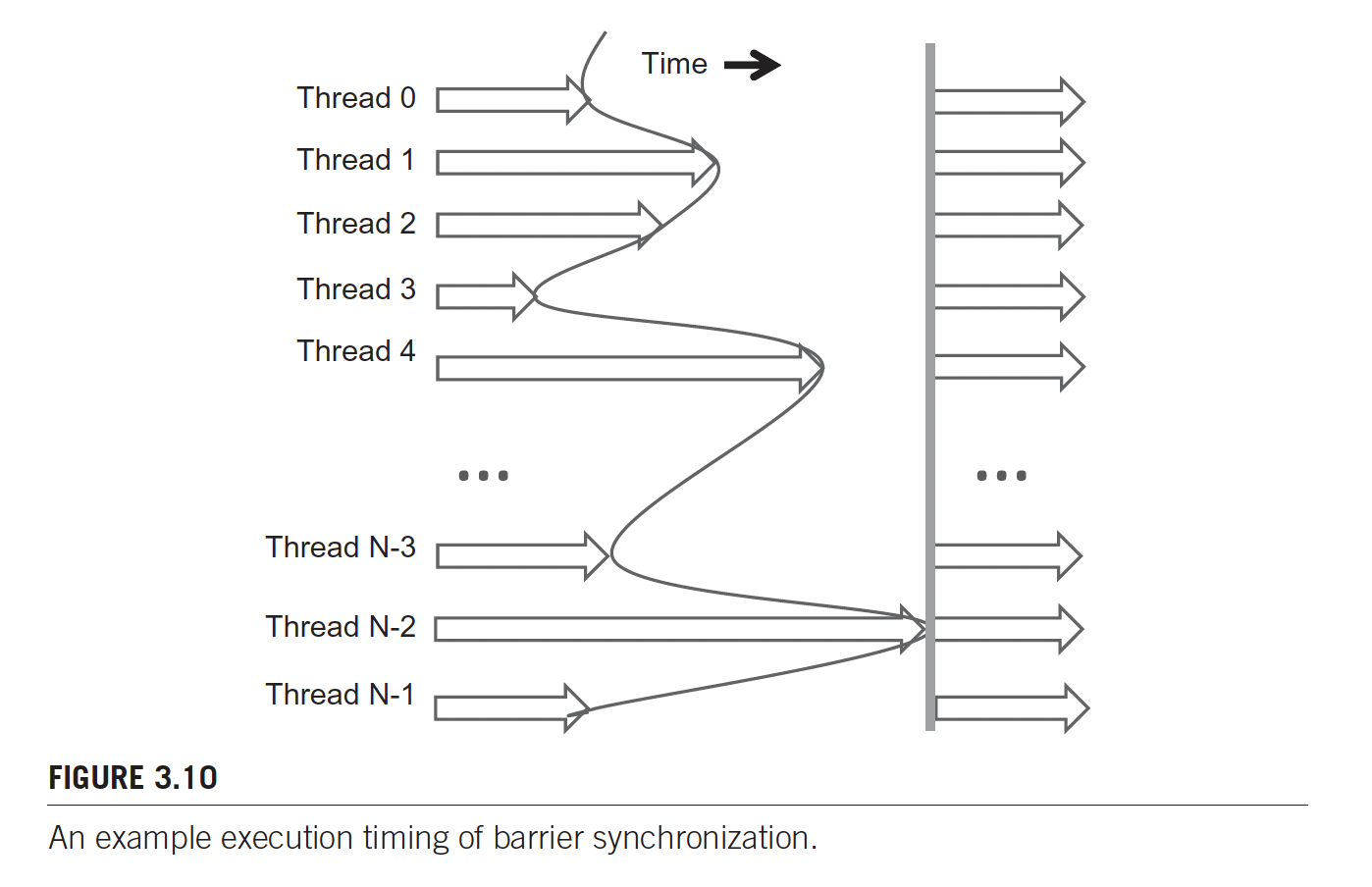
Reusable barriers
A one-shot barrier is just a latch: count down to 0, release, done. A reusable barrier resets each cycle, which needs a generation counter so late arrivers from cycle N don’t slip through into cycle N+1. See uBarrier for the uC++ coroutine-based implementation.
CS343, 3-task ordered example (Buhr §6.3.3)
Three tasks must execute S1/S2/S3 before any runs S5/S6/S7:
T1::main() {        T2::main() {        T3::main() {
    ...                 ...                 ...
    S1                  S2                  S3
    b.block();          b.block();          b.block();        // gather point
    S5                  S6                  S7
}                   }                   }

int main() {
    Barrier b( 3 );                         // 3 tasks must arrive
    T1 x( b ); T2 y( b ); T3 z( b );
}
The barrier blocks the first N−1 callers; the Nth task trips it and all release together. Total arrivals must be declared up front.
One-shot vs. cyclic
  ┌───┐             ┌───┐   ┌───┐
  │   │ one-shot    │   │   │   │ cyclic
  │   │             │   │   │   │
  └───┘             └───┘   └───┘
  start              start   end   start   end
Cyclic reuse is where the reinitialization problem bites, a fast thread racing ahead into cycle N+1 before a slow cycle-N thread has left the barrier.
Coordinator / Workers two-barrier pattern (§6.3.3)
Two barriers let the coordinator accumulate results while workers re-initialize for the next round, without either side stalling the other:
Barrier start( G + 1 ), end( G + 1 );       // G workers + 1 coordinator

// Coordinator                              // Worker
// general initialization                   // worker initialize
start.block();                              start.block();          // all ready
// do other work (or collect subtotals)     // do work (produce subtotal)
end.block();                                end.block();             // all done
// close down / loop                        // close down or reinit
Alternative: last worker does coordination, but then workers can’t re-initialize during coordination. Two barriers is cleaner.
Why not spawn fresh tasks each cycle? Task creation/deletion is expensive, so barriers on reusable workers beat it.